top of page
"Forgotten Fire: The Lost Works of Ken Oswald '__yak' Vann, Jr."
"Forgotten Fire: The Lost Works of Kenneth “__yak” Vann Jr." gathers a body of artworks created over a decade ago and rediscovered in the present with new urgency. These pieces arrive as evidence from an earlier creative life: political studies, cultural portraits, Greek-letter tribute commissions, unfinished works, experiments on paper, wood, and archival surfaces, and images made before the artist’s current language fully sharpened into the force of "REIGNITED".
The collection is not simply a look backward. It is a recovery of instinct. Long before the formal architecture of the current series, these works were already wrestling with power, memory, Black cultural identity, American contradiction, reverence, resistance, and the charged symbolism of public figures. Some pieces are raw. Some are unresolved. Some carry the marks of speed, pressure, humor, anger, grief, or devotion. Together, they reveal an artist building a vocabulary in real time.
Created before a decade-long hiatus from studio practice, these artworks now function as an archive of becoming. They show the early foundation of a practice rooted in political critique, visual storytelling, portraiture, satire, street language, historical consciousness, and cultural preservation. What once seemed lost now reads like prophecy: fragments of a voice that never disappeared, only waited.
"Forgotten Fire" is about return. It is about finding proof that the flame was always there.
Project type
Lost Artworks
Date
DEC 2016
Location
Atlanta, GA

01
"Forgotten Fire: The Lost Works of Ken Oswald '__yak' Vann, Jr."

01
"escorted from justice"
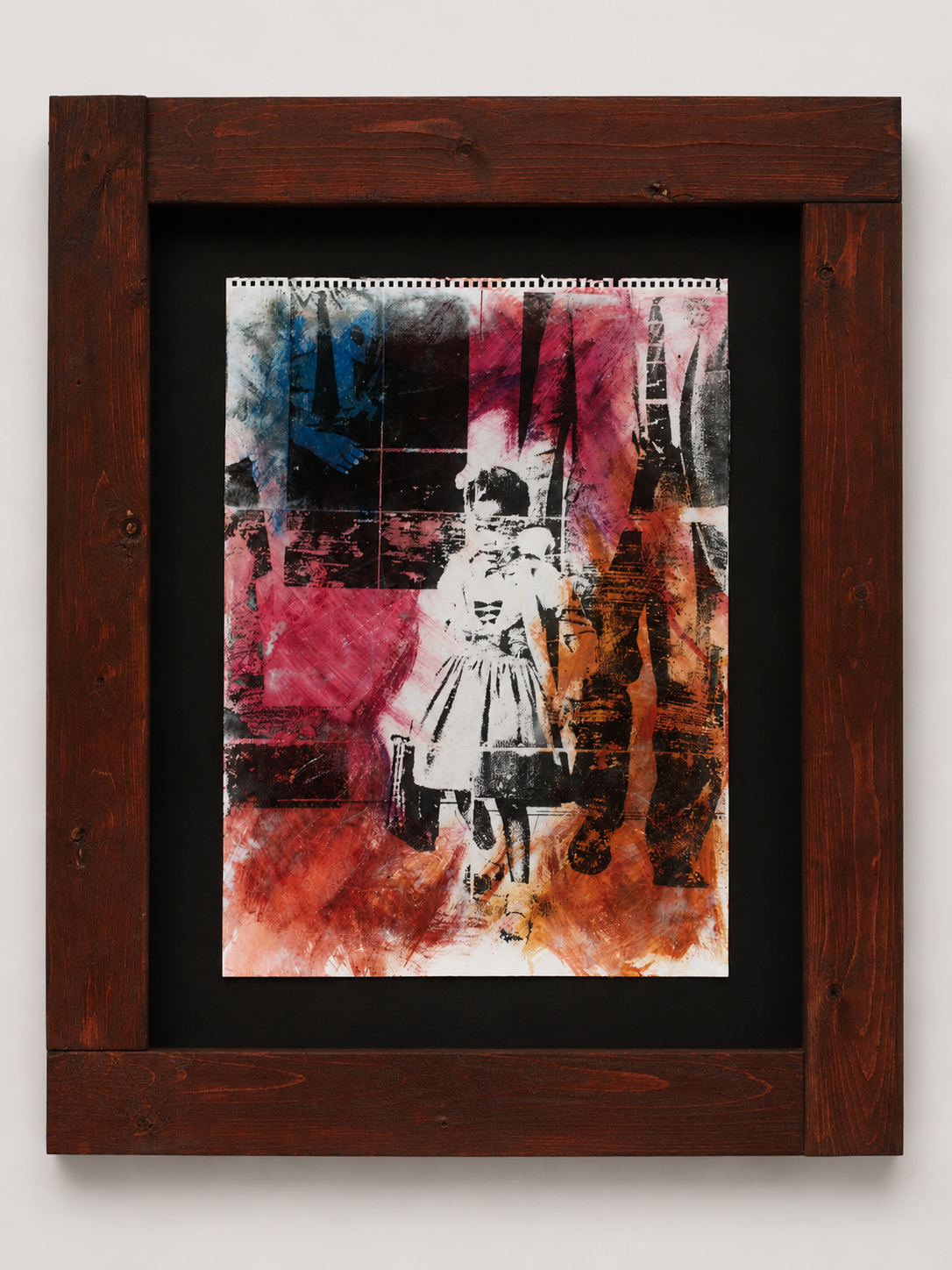
In "Escorted from Innocence", Ken Oswald “__yak” Vann Jr. revisits the historic image of Ruby Bridges being escorted from William Frantz Elementary School by U.S. Marshals during the court-ordered desegregation of New Orleans schools in 1960. Rather than reproducing the scene as heroic illustration, Vann translates it into a field of stain, rupture, and partial disappearance. Ruby’s small white figure emerges from a fractured ground of black panels, red washes, rust-orange abrasion, and blue-black residue — present, protected, exposed, and already becoming history.
The painting’s emotional force comes from its refusal to sentimentalize Ruby Bridges. She is not presented as a symbol of easy progress. She appears as a child made visible by the failure of a nation around her. The escorting figures, architectural forms, and school-like fragments do not resolve into a stable setting; they press against her as systems, documents, walls, and shadows. The work understands that the violence of the event was not only in the crowd outside the school, but in the fact that a child required federal protection to receive an education.
Created more than a decade ago on heavy watercolor paper, and now lost, the work occupies an important place in Vann’s early development. It anticipates his later concerns with archive, historical repetition, racial memory, and the transformation of public history into layered visual evidence. The medium is essential: watercolor bleeds, stains, and refuses total containment, allowing the image to behave like memory itself — unstable, damaged, but persistent.
Escorted from Innocence stands in conversation with Norman Rockwell’s The Problem We All Live With, but it does not simply echo Rockwell’s iconic civil-rights image. Where Rockwell clarified the scene into national allegory, Vann fractures it into aftermath. This is Ruby Bridges not as a clean emblem of integration, but as a child moving through the residue of American contradiction. The painting asks the viewer to look again at a familiar image and recognize the unresolved problem inside it: the child was brave because the adults were dangerous.

02
"ain't no we"
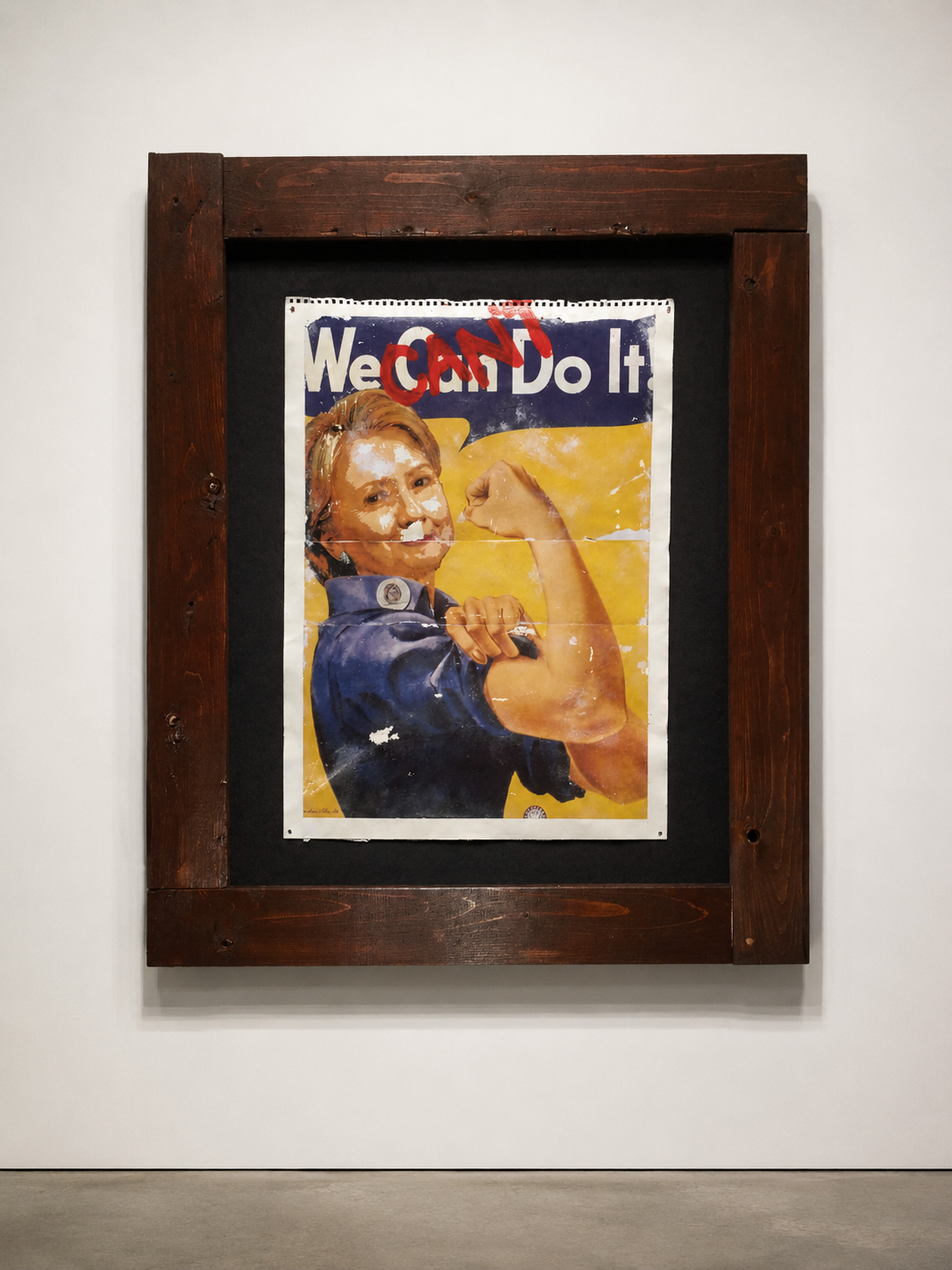
In "ain't no we", Ken Oswald “__yak” Vann Jr. transforms one of America’s most recognizable images of female empowerment into a post-election indictment. Made directly after Hillary Clinton’s 2016 loss to Donald Trump, the work parodies the visual language of J. Howard Miller’s World War II-era “We Can Do It!” poster, replacing its familiar optimism with a red acrylic interruption: CAN’T.
The gesture is immediate, abrasive, and unsentimental. Clinton’s campaign carried the symbolic weight of a historic first: the possibility of the first woman president of the United States. Around that possibility gathered decades of feminist aspiration, liberal confidence, campaign branding, and “glass ceiling” mythology. Vann’s painting collapses that expectation into a single act of visual defacement. The flexed arm remains. The smile remains. The patriotic palette remains. But the slogan fails.
Rather than treating Clinton’s defeat as an isolated political event, "ain't no we" reads it as a rupture in American self-image. The work asks what happens when empowerment becomes a slogan before it becomes power; when representation is mistaken for inevitability; when the iconography of progress cannot survive contact with the machinery of the state. The red CAN’T functions as parody, protest, and postmortem — a correction scrawled across the face of national optimism.
As a lost 18 x 24-inch acrylic painting on archival paper, the work now exists through documentation, which intensifies its relationship to political memory. It is both artifact and aftershock: a record of the moment when a country that had been told history was moving in one direction watched it break sharply in another. In Vann’s hands, the poster no longer rallies the viewer. It stares back with the exhausted absurdity of a promise that did not hold.

03
"crazy white devils, again"
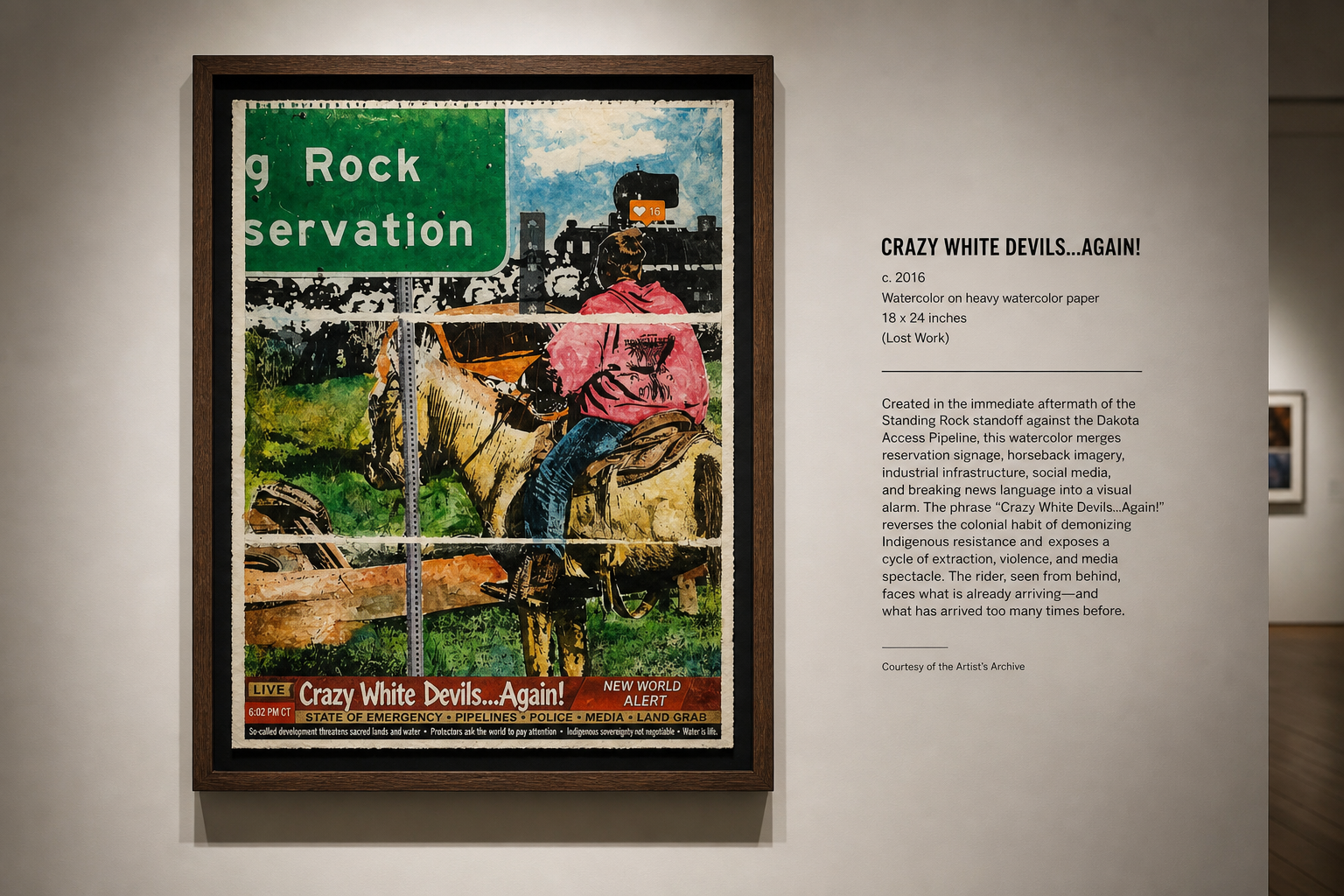
Crazy White Devils...Again! is a lost 18 × 24 inch watercolor on heavy watercolor paper created directly after the Standing Rock standoff against the Dakota Access Pipeline. Combining reservation signage, horseback imagery, industrial forms, social-media symbolism, and a breaking-news banner, the painting transforms a contemporary Indigenous land and water struggle into a charged visual alarm.
At the center of the work, a rider on horseback faces away from the viewer beneath the cropped language of Standing Rock Reservation. The figure’s turned back refuses spectacle. They are not presented as victim, mascot, or simplified symbol of resistance. They are witness — positioned between ancestral continuity and modern infrastructure, between land memory and media emergency. Around them, the image fractures into signs, folds, panels, and warnings, as if the paper itself has become a contested map.
The phrase “Crazy White Devils...Again!” gives the painting its blunt political force. Written like a breaking-news alert, the line reverses the historical language of demonization often projected onto Indigenous resistance. In this image, irrationality does not belong to those defending water, land, and sacred sites. It belongs to the recurring machinery of settler entitlement: the pipeline, the police line, the permit, the headline, the corporate route, the official explanation. The word “Again” turns the painting from protest response into historical diagnosis.
Made in the immediate aftermath of Standing Rock, the work captures the moment when a local fight over water and sovereignty became a global image of Indigenous resistance. Yet the painting is not simply documentary. It is prophetic in structure. Its news-banner format understands that the violence of extraction is constantly repackaged as development, that state force is often narrated as order, and that Indigenous defense must fight not only physical incursion but also the media systems that frame the story.
As a lost work, Crazy White Devils...Again! now exists through memory and documentation, which only deepens its resonance. The painting becomes an artifact of urgency: a record of what the artist saw, felt, and understood in the wake of Standing Rock. It belongs to a lineage of politically conscious American art that treats image-making as testimony, satire, refusal, and indictment. Its power lies in its lack of neutrality. It does not ask whether history is repeating. It announces that it already has.

04
"before I had words"
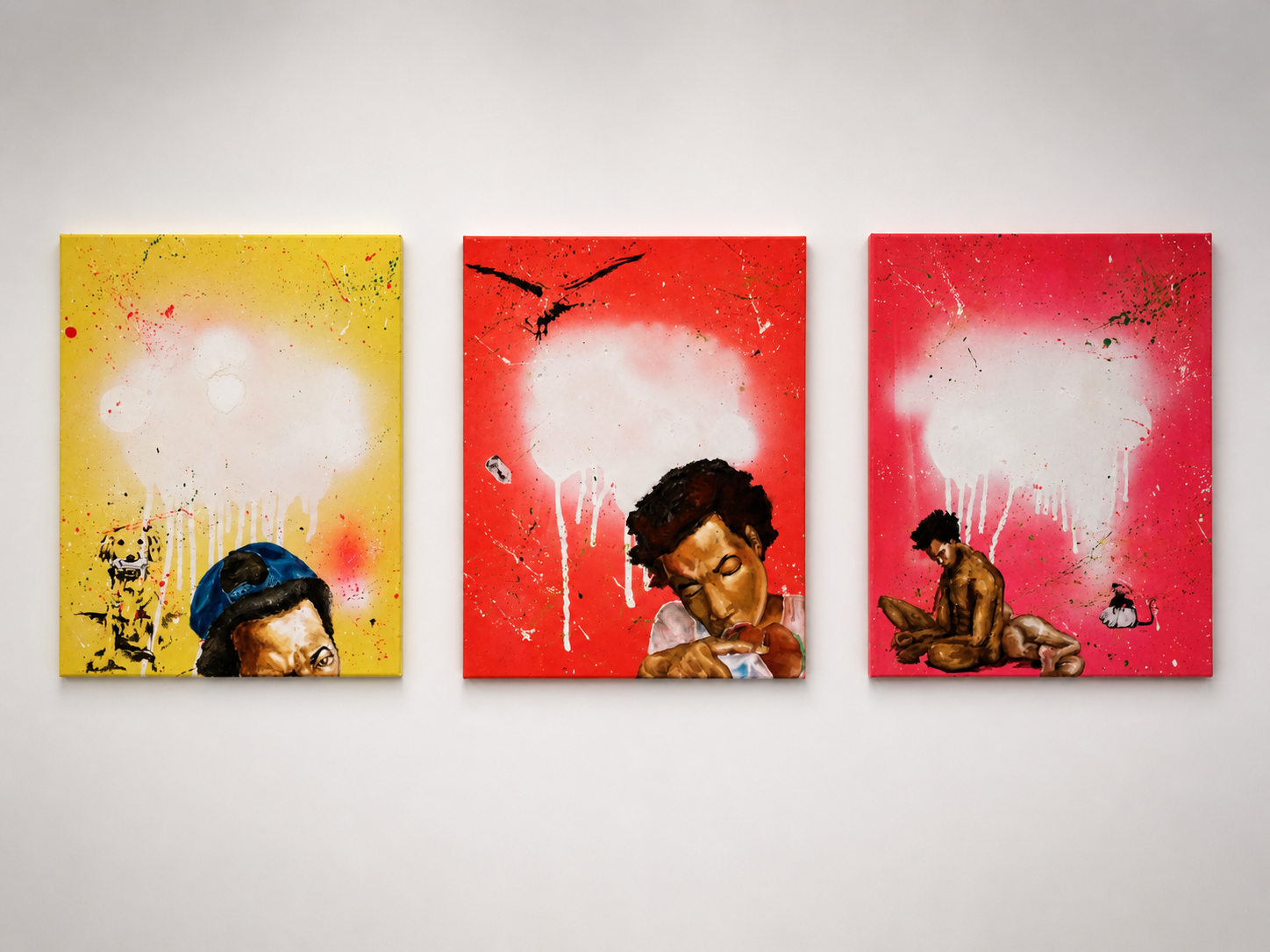
Before I Had Words gathers three unfinished acrylic paintings that read less like abandoned works than interrupted transmissions. Across the canvases, young Black figures appear beneath large white atmospheric forms—part cloud, thought bubble, smoke plume, erasure, and unfinished ground. These blank spaces hover over the bodies like language that has not yet arrived. They suggest interior life before articulation: emotion before statement, memory before testimony, pressure before release.
The paintings carry the visual grammar of street art and early studio experimentation: saturated fields of yellow, red, and pink; splattered acrylic; hard drips; partial portraiture; raw graphic marks; and figures placed low in the composition, as though pushed toward the margins by the weight of what remains unsaid above them. The unfinished quality becomes central to the work’s meaning. The missing passages are not failures of completion. They become evidence—of youth, searching, restraint, and the artist’s early attempt to locate a visual language for vulnerability, masculinity, identity, and survival.
Seen a decade later, these works operate like artifacts from a formative period. They show an artist testing the distance between graffiti gesture and intimate portraiture, between public mark-making and private psychological space. The figures do not perform confidence; they sit with uncertainty. One peers upward from the edge of the canvas, one bends inward in quiet concentration, one folds into himself beside a small animal-like presence. Each figure is held beneath a cloud of potential meaning, as if the painting is waiting for the vocabulary that the artist would later develop.
Before I Had Words is therefore not simply a title about unfinished paintings. It is a statement about origin. These works mark the moment before fluency—before the mature series, before the sharpened politics, before the full command of symbol, material, and voice. They reveal the early architecture of an artistic language still forming: bodies under pressure, color as atmosphere, blankness as tension, and silence as a kind of testimony.

05
lost artworks
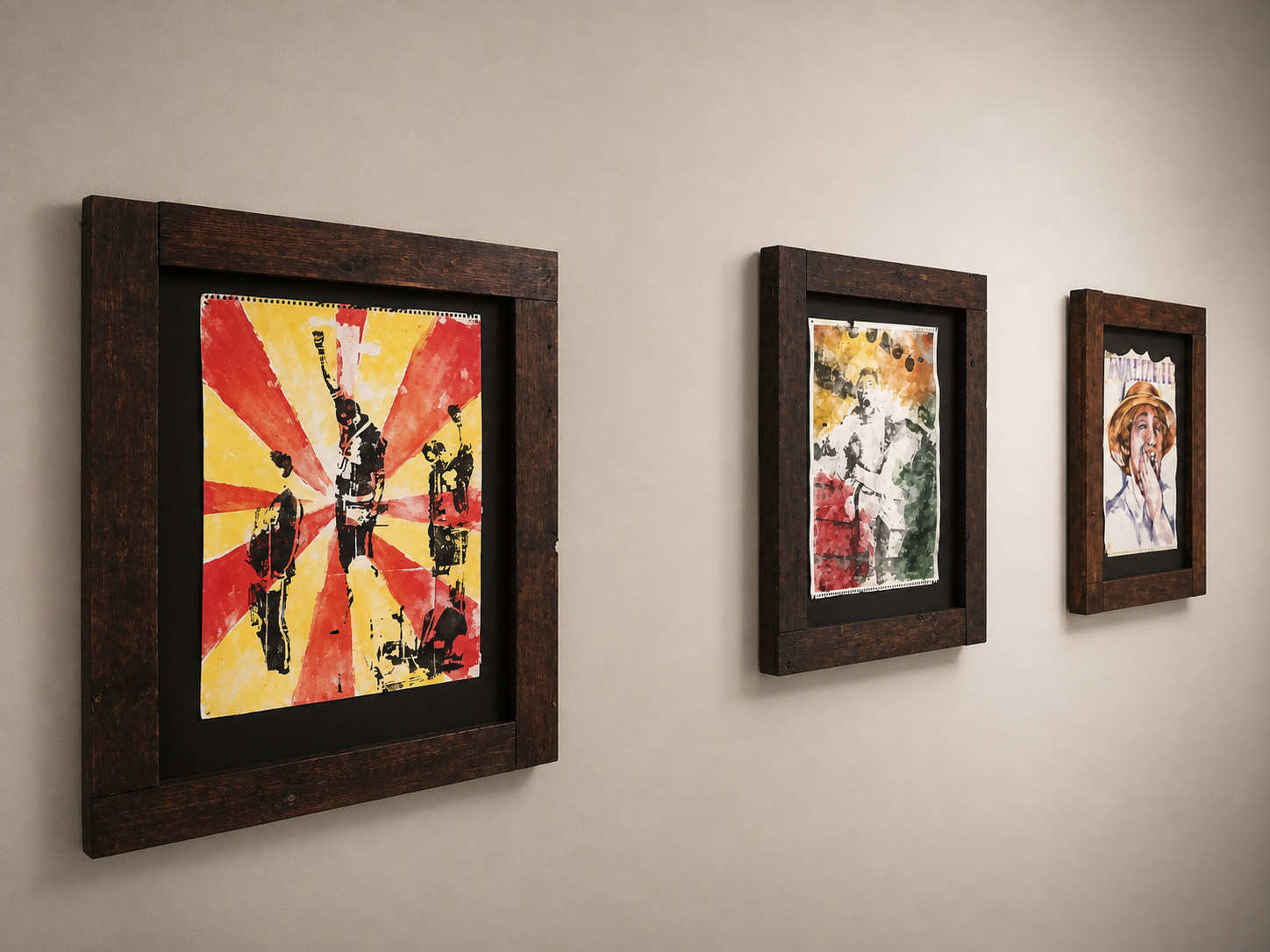
This early body of work stages music, memory, and Black cultural expression as both image and atmosphere. Presented in rough, dark wooden frames, the pieces feel less like polished objects and more like recovered artifacts—personal relics pulled from a wall, a bedroom, a dorm room, a hallway, or the back corner of a small venue where somebody was always making something happen.
Across the three works, the hand is loose but intentional. Figures emerge through washes, splatters, stencil-like silhouettes, and exposed paper edges. The surfaces refuse perfection. Spiral-bound borders, uneven cropping, and raw marks become part of the language, giving the works the immediacy of sketchbook pages elevated into public testimony. They carry the rhythm of someone working fast, young, and instinctively—building images from sound, gesture, and cultural memory rather than academic restraint.
The left work, with its red-and-yellow burst and silhouetted performers, reads like a declaration: sound as uprising, performance as ceremony, the body as amplifier. The central piece softens that volume into a more spectral register, where the performer appears half present, half dissolving into smoke, echo, and watercolor residue. The right work turns inward, holding a portrait in a quieter emotional key—intimate, stylish, guarded, and expressive at once.
Together, the works document an artist already negotiating the space between tribute and rebellion. They point toward themes that would later become central: Black performance, archival recovery, street-informed composition, political energy, and the transformation of everyday materials into cultural evidence. What makes the grouping compelling is not just its subject matter, but its honesty. These are not overdetermined works trying to explain themselves. They are early signals—raw, imperfect, alive—showing an artist learning how to turn sound, identity, and atmosphere into image.

06
MAY 02 1973
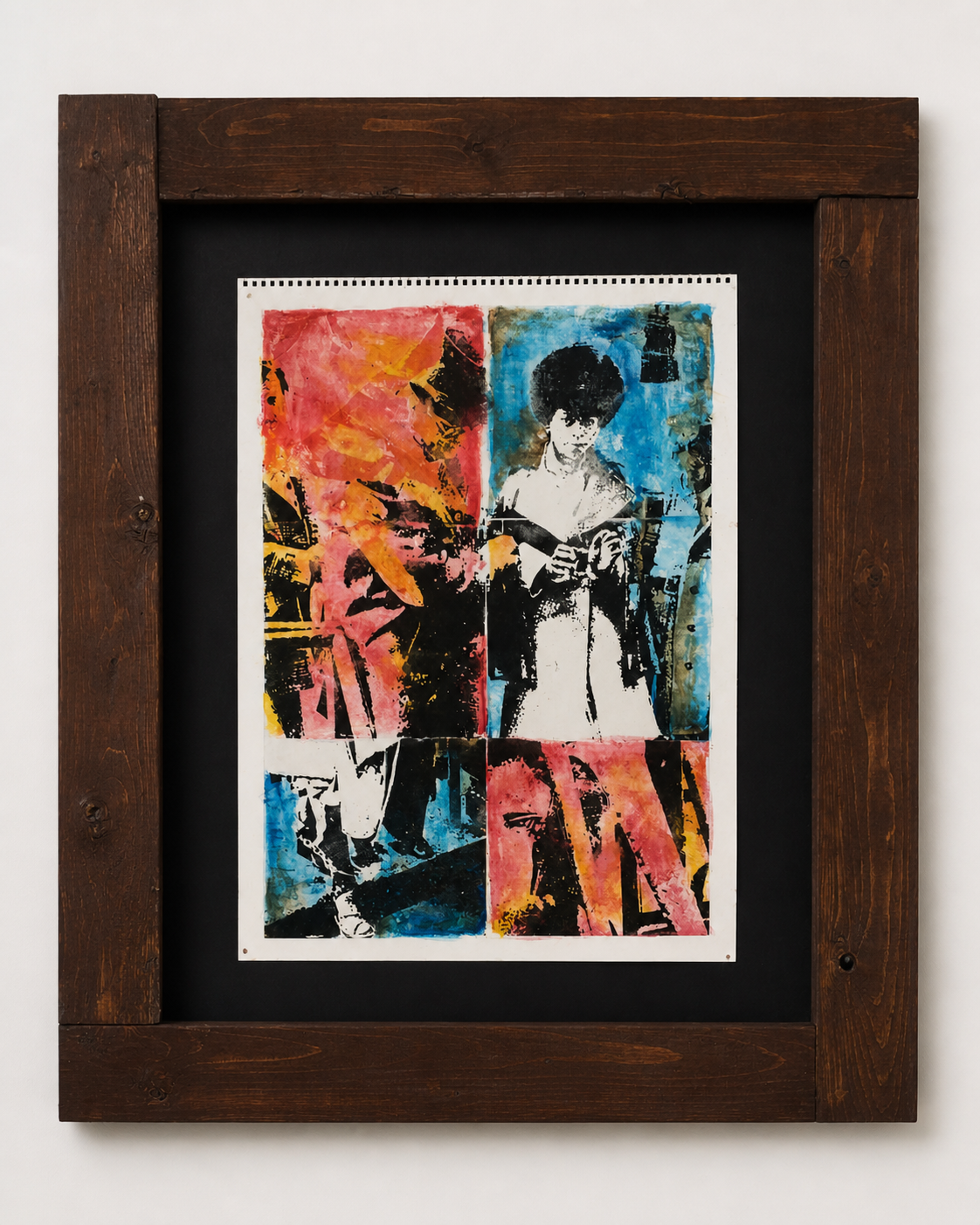
"May 02 1973" depicts the 1973 arrest of Assata Shakur after the New Jersey Turnpike confrontation that left State Trooper Werner Foerster and Zayd Malik Shakur dead, and Shakur herself wounded. Rather than render the event as documentary realism, Kenneth “__yak” Vann Jr. fractures the scene into a four-part field of color, stencil, and visual interference. The result is not a single image of arrest, but an image of historical contest: red heat against blue authority, embodied vulnerability against official record, witness against archive.
Painted in watercolor on heavy paper, the work pushes a traditionally delicate medium into the language of protest graphics, street residue, photocopy degradation, and political poster art. The central figure appears partially exposed, partially erased, and partially translated into evidence. Around her, black marks interrupt the surface like damaged newsprint, police-file reproduction, or the remnants of a wheat-pasted image on a public wall.
The painting belongs to the contested afterlife of Assata Shakur’s image. To the state, Shakur was a convicted fugitive and later the first woman named to the FBI’s Most Wanted Terrorists list. To many in Black radical, abolitionist, and liberation traditions, she became a symbol of political persecution, survival, exile, and resistance. Hands Raised on the Turnpike does not flatten that conflict into easy resolution. Instead, it stages the arrest as a visual argument about power: who gets named, who gets hunted, who gets believed, and whose wounded body is permitted to testify.
Now lost and known only through photographic documentation, the painting has acquired an additional layer of meaning. A work about a contested archive has itself become an archival fragment. Its disappearance intensifies its subject. What remains is an image about state capture, historical rupture, and the fragile survival of Black radical memory.

07
"untitled"
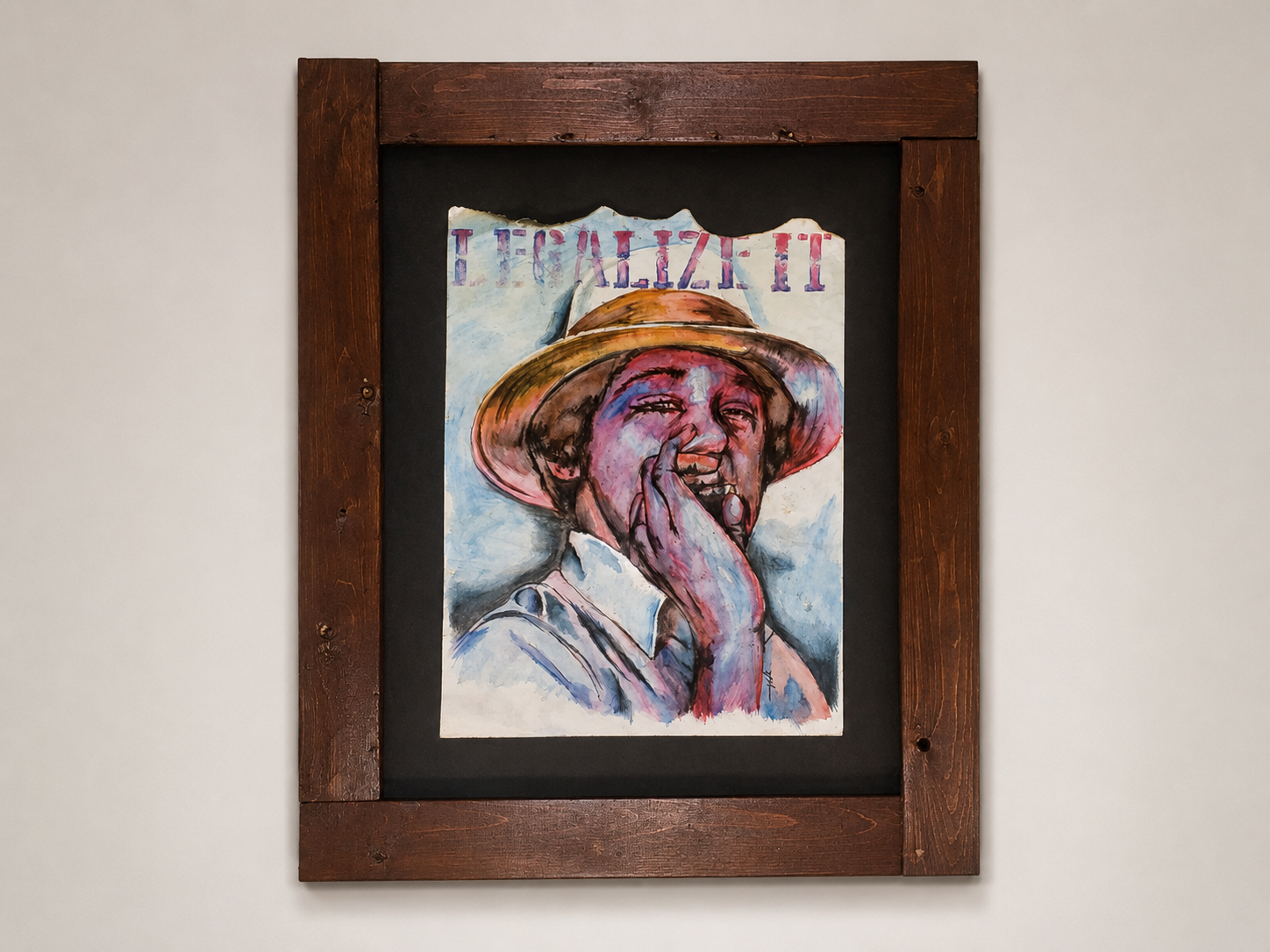
This untitled artwork is an 18 × 24 watercolor on heavy watercolor paper depicting a young, college-era Barack Obama beneath the phrase “LEGALIZE IT.” Made more than a decade ago, the work functions as both portrait and indictment, returning Obama to the unstable period before presidential polish, before official portraiture, before the disciplined image of constitutional authority.
The painting draws its power from contradiction. Obama’s youthful marijuana use became part of his public biography — at times humorous, at times politically risky, but ultimately survivable. For countless others, especially Black and brown Americans, similar acts were met not with memoir, myth, or political ascent, but with arrest, surveillance, incarceration, and permanent civic consequence. In this context, the phrase “LEGALIZE IT” becomes less a casual cannabis slogan than a demand aimed at the architecture of unequal punishment.
Rendered in loose, volatile washes of red, violet, blue, and brown, the portrait resists the smoothness of presidential imagery. Obama appears not as monument, but as young man: laughing, thinking, hiding, smoking, or speaking through the raised hand. That ambiguity is the work’s force. The gesture refuses a single reading, just as Obama’s own biography refuses easy separation from the racial politics of criminalization and respectability.
The rough edge of the watercolor paper gives the piece the feeling of a recovered artifact — part campus relic, part protest poster, part private memory. Above the figure, the faded block letters of “LEGALIZE IT” hover like a slogan weathered by music, law, stigma, and time. Seen now, after cannabis has moved from contraband to legal commodity in much of American culture, the painting asks a harder question: who gets to outgrow illegality, and who is made to carry it forever?

08
"Finer in Blue"
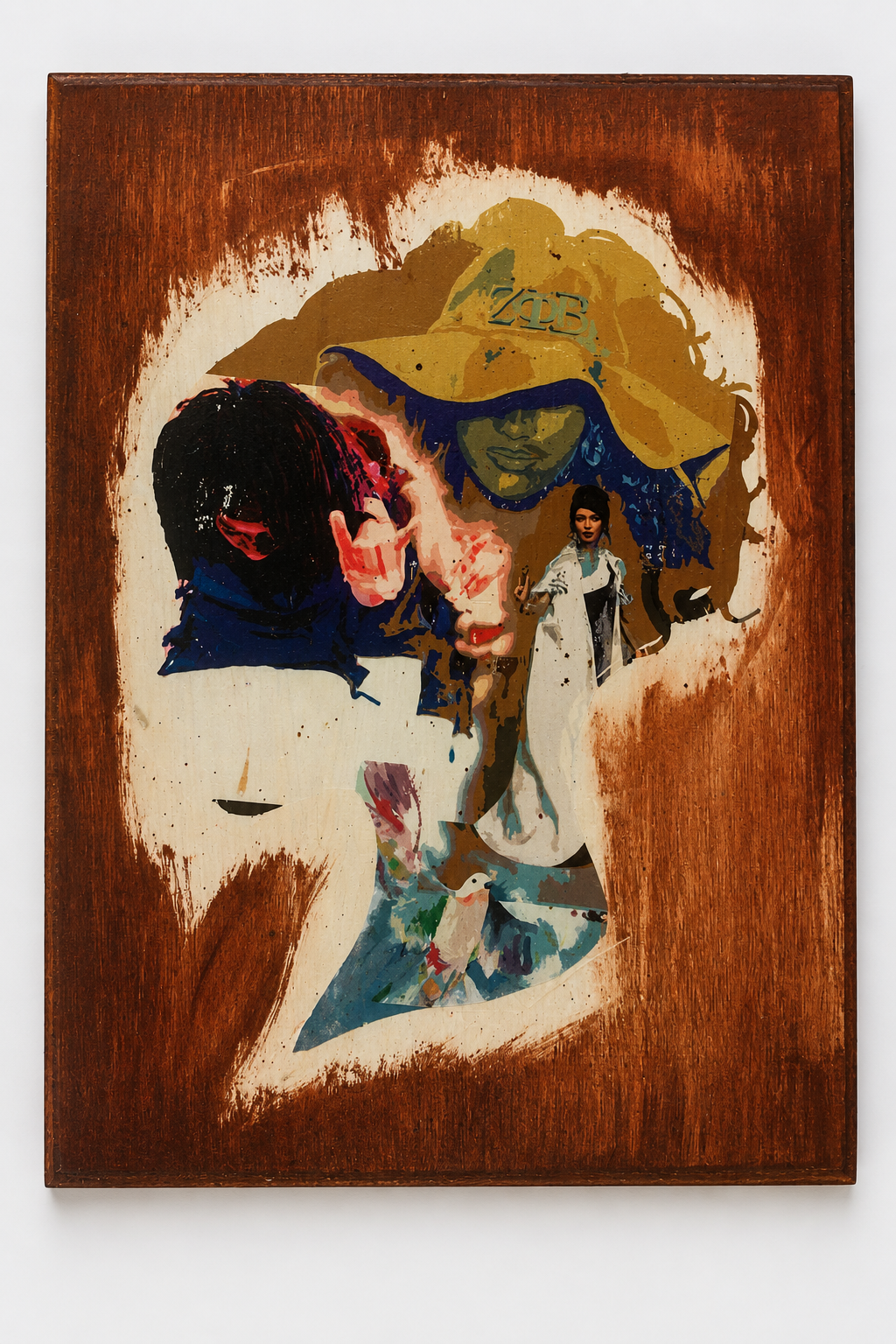
"Finer in Blue: A Zeta Study on Cedar" is an early commissioned tribute to Zeta Phi Beta Sorority, Incorporated, painted in acrylic on an intimate 8 × 10 inch cedar panel. Rather than approaching Greek-letter identity as simple decoration, the work builds a layered visual field of affiliation, femininity, memory, and symbolic inheritance.
At the center of the composition, a woman in a wide-brimmed hat bearing the letters ΖΦΒ appears partially veiled by shadow and color. Her presence is both portrait and emblem: composed, guarded, and ceremonial. Around her, expressive hands, fashion-like collage, abstract paint passages, and a dove motif create a compact language of sisterhood, cultural pride, and personal transformation.
The cedar ground gives the painting its object-like intimacy. Its exposed grain, warm brown field, and rough white silhouette transform the panel into something closer to a devotional keepsake than a conventional portrait. The work honors Zeta Phi Beta’s visual and symbolic codes—royal blue, white, the dove, and the sorority’s ideal of finer womanhood—while filtering them through an early mixed-media sensibility rooted in gesture, collage, and Black cultural image-making.
Created over a decade ago, the painting now reads as both tribute and evidence: a small but revealing example of an artist beginning to fuse commissioned symbolism with a broader language of identity, history, and layered representation.

09
"all bark"
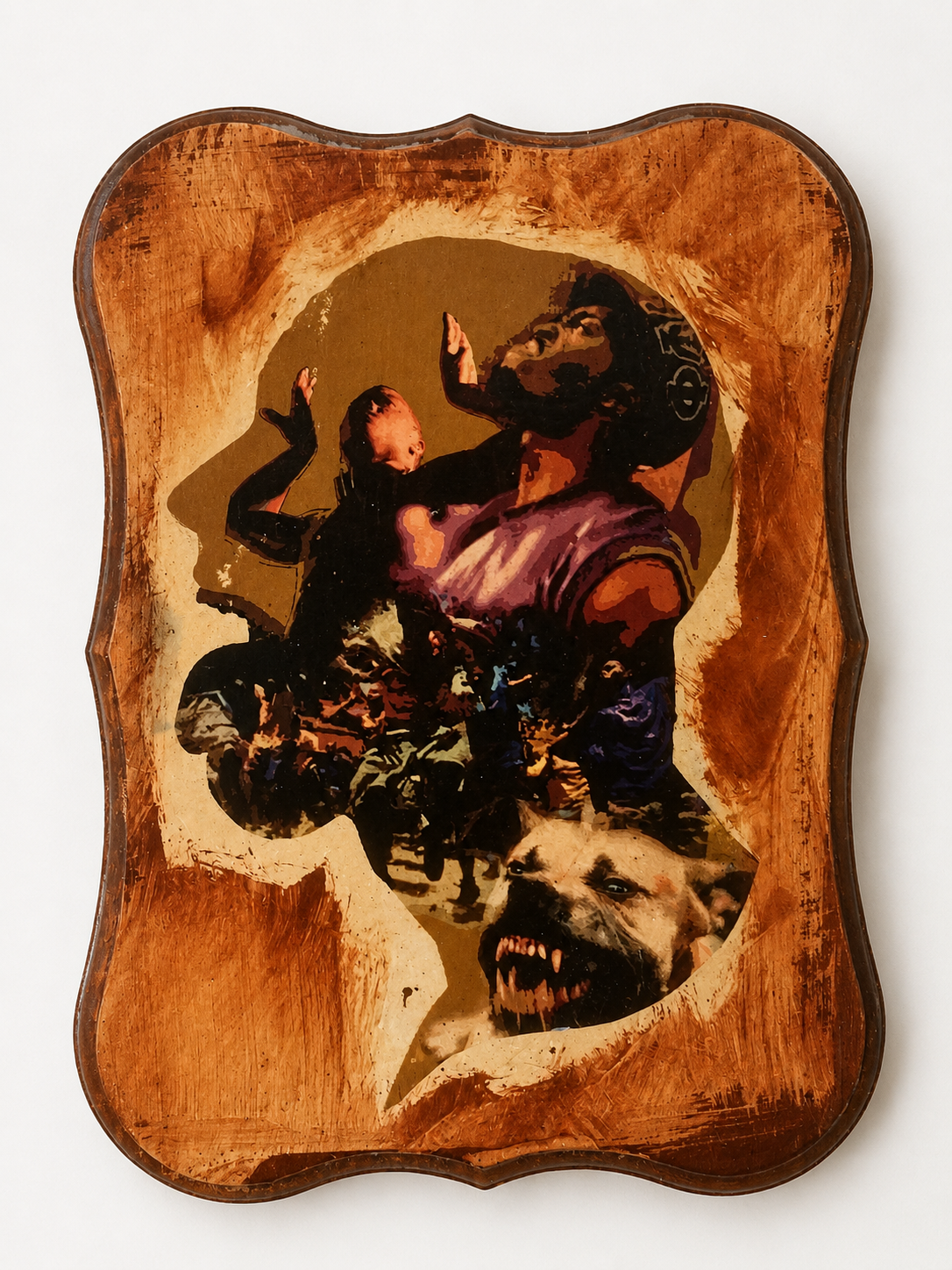
an 8 x 10 inch acrylic painting on cedar wood created as a commissioned tribute to Omega Psi Phi Fraternity, Inc. Made over a decade ago, the work reflects an early stage in the artist’s developing visual language: layered symbolism, devotional composition, cultural memory, and raw material presence.
Rather than presenting fraternity identity through emblem alone, the painting approaches Omega Psi Phi as an inheritance of struggle, protection, discipline, and uplift. A central male figure cradles and raises a child within a dense field of shadowed bodies, animal force, and warm cedar grain. The image suggests initiation, guardianship, sacrifice, and the burden of carrying legacy forward. Purple tones, dramatic contrasts, and the carved plaque-like support situate the work between fraternal tribute, sacred icon, and ancestral memorial.
The cedar wood ground gives the piece an object-like permanence. Its warm, weathered surface transforms the painting into something closer to a personal relic than a conventional portrait. Rough brushwork and compressed imagery reveal the hand of an artist already invested in collage logic, symbolic density, and the fusion of cultural history with intimate memory.
Viewed now, Lift Every Brother stands as both a tribute and a marker of artistic formation. It captures an early attempt to translate brotherhood into visual architecture: not as decoration, but as duty, protection, lineage, and survival.

10
"bigger than a ring"
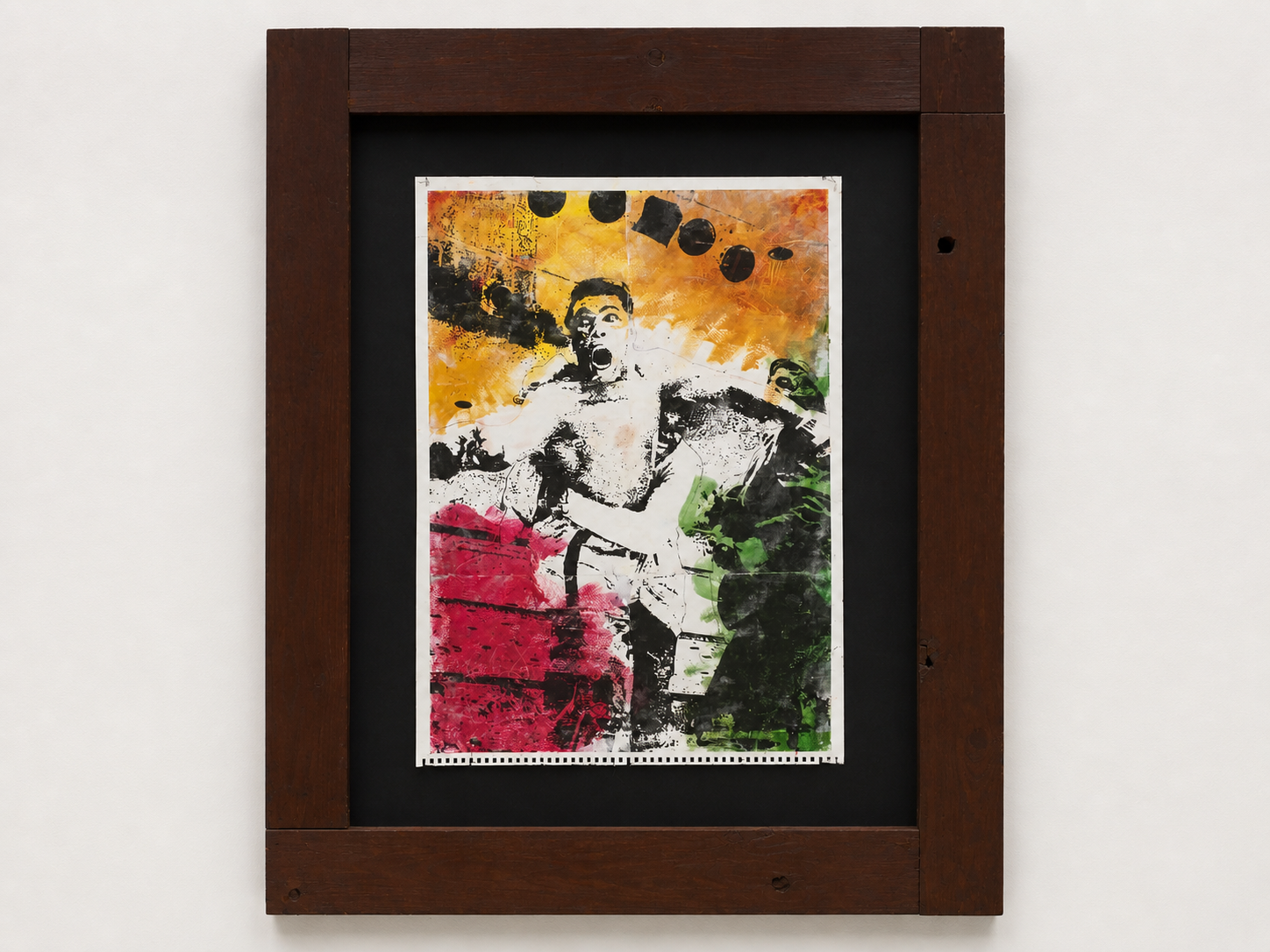
In "Bigger Than a Ring", Kenneth “__yak” Vann Jr. revisits Muhammad Ali not as a settled icon, but as an eruption. Created over a decade ago on heavy watercolor paper, the lost 18 × 24 inch work captures Ali at the threshold between athlete and historical force: mouth open, body fractured by black graphic marks, surrounded by a volatile field of red, green, orange, yellow, white, and black.
The painting refuses the safe commemorative image. Ali is not presented as nostalgia. He is rendered as pressure — the pressure of spectacle, Black pride, public punishment, religious conviction, political dissent, and global fame. The work draws from the visual language of protest posters, boxing ephemera, street graphics, and Pan-African symbolism, transforming watercolor into something closer to impact residue.
Red and green gather at the base of the composition while a heated orange field burns above, suggesting both the ring and the world stage. The black circular forms across the top hover like lights, punches, cameras, or historical afterimages. At the center, Ali’s open mouth becomes the painting’s true subject. It is the shout before the punch, the poem before the bell, the refusal before the sentence, the victory before the myth.
As an early work in Vann’s practice, Ali, Before the Bell Became History anticipates many of the concerns that would later define his mature mixed-media language: Black cultural memory, distressed surfaces, political symbolism, graphic figuration, and the transformation of public history into intimate visual testimony. Now lost, the painting survives as both image and artifact — evidence of an artist already wrestling with how Black icons are made, punished, consumed, and ultimately reclaimed.

11
"twenty pearls"
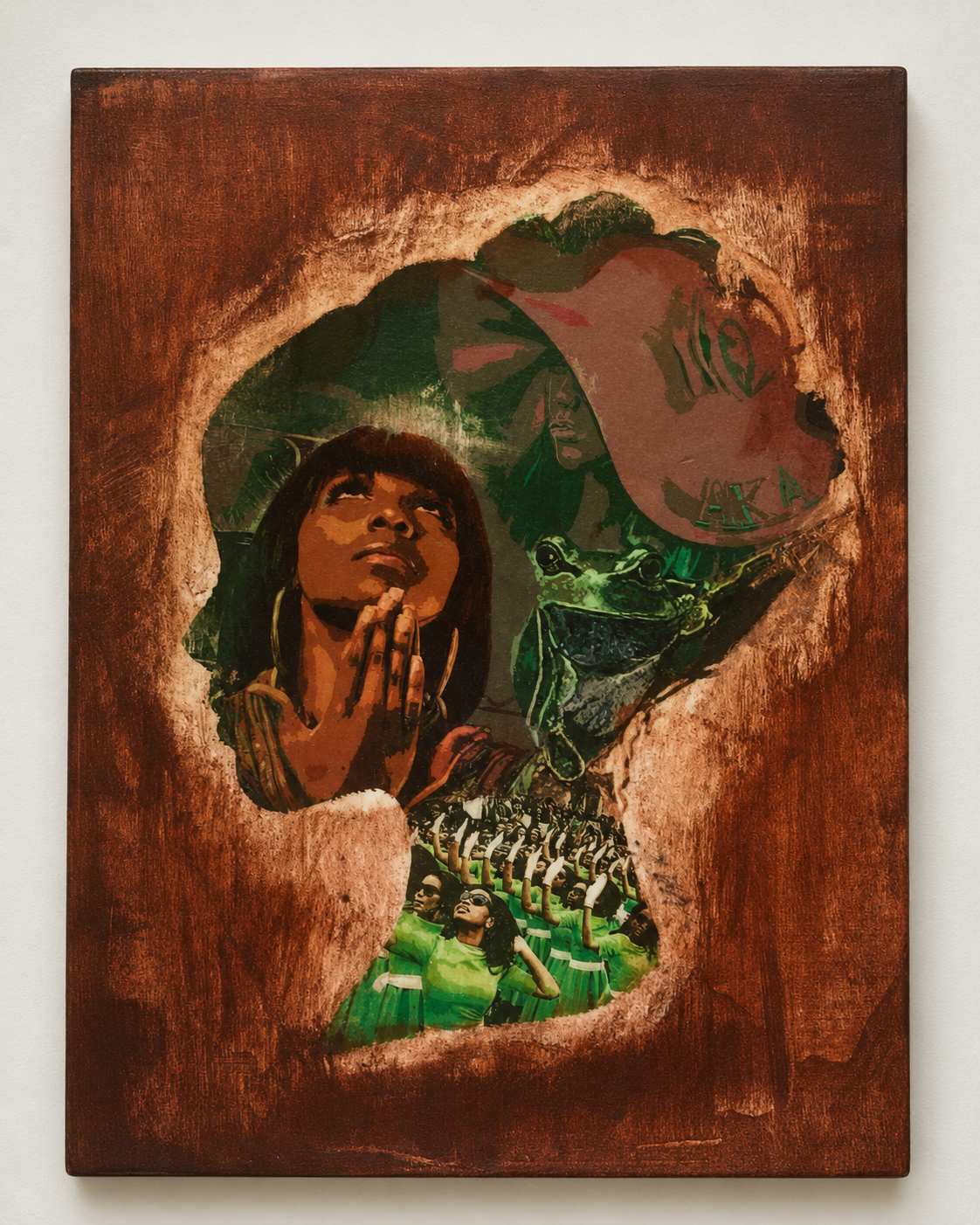
Twenty Pearls in the Wood is an 8 × 10 acrylic painting on cedar wood created as a tribute to Alpha Kappa Alpha Sorority, Incorporated, and to the enduring legacy of Black women who build, preserve, and transform communities through sisterhood and service.
The cedar panel gives the work the feeling of an heirloom. Its warm, reddish-brown surface suggests memory, protection, and preservation, while the central opening evokes the shape of Africa—an ancestral portal through which the imagery emerges. Rather than treating the tribute as simple symbolism, the painting situates Alpha Kappa Alpha within a larger continuum of diasporic memory, womanhood, education, and cultural inheritance.
At the center, a young Black woman looks upward with her hands gathered near her chin. Her expression holds prayer, aspiration, reflection, and resolve. She represents the woman becoming: the student, the initiate, the legacy bearer, the sister entering a tradition that asks her not only to belong, but to serve.
The frog-like figure functions as a symbol of transformation and threshold. Within the visual language of the piece, it becomes a guardian of transition—a marker of growth, crossing, and renewal. Below, repeated women in green gather like a line, a chapter, a chorus, or a procession. Their presence speaks to the collective power of sisterhood: one woman rising, many women carrying her, and generations moving in rhythm toward a shared standard.
The painting’s pink and green atmosphere, its references to pearls, ivy, and formation, and its compact scale all contribute to its devotional quality. It is a small work, but it holds the weight of ritual, memory, and institutional pride. Twenty Pearls in the Wood honors Alpha Kappa Alpha not only through color and symbol, but through the deeper spirit of refinement, scholarship, grace, leadership, and service that the sorority has carried for more than a century.

12
"without anthem"
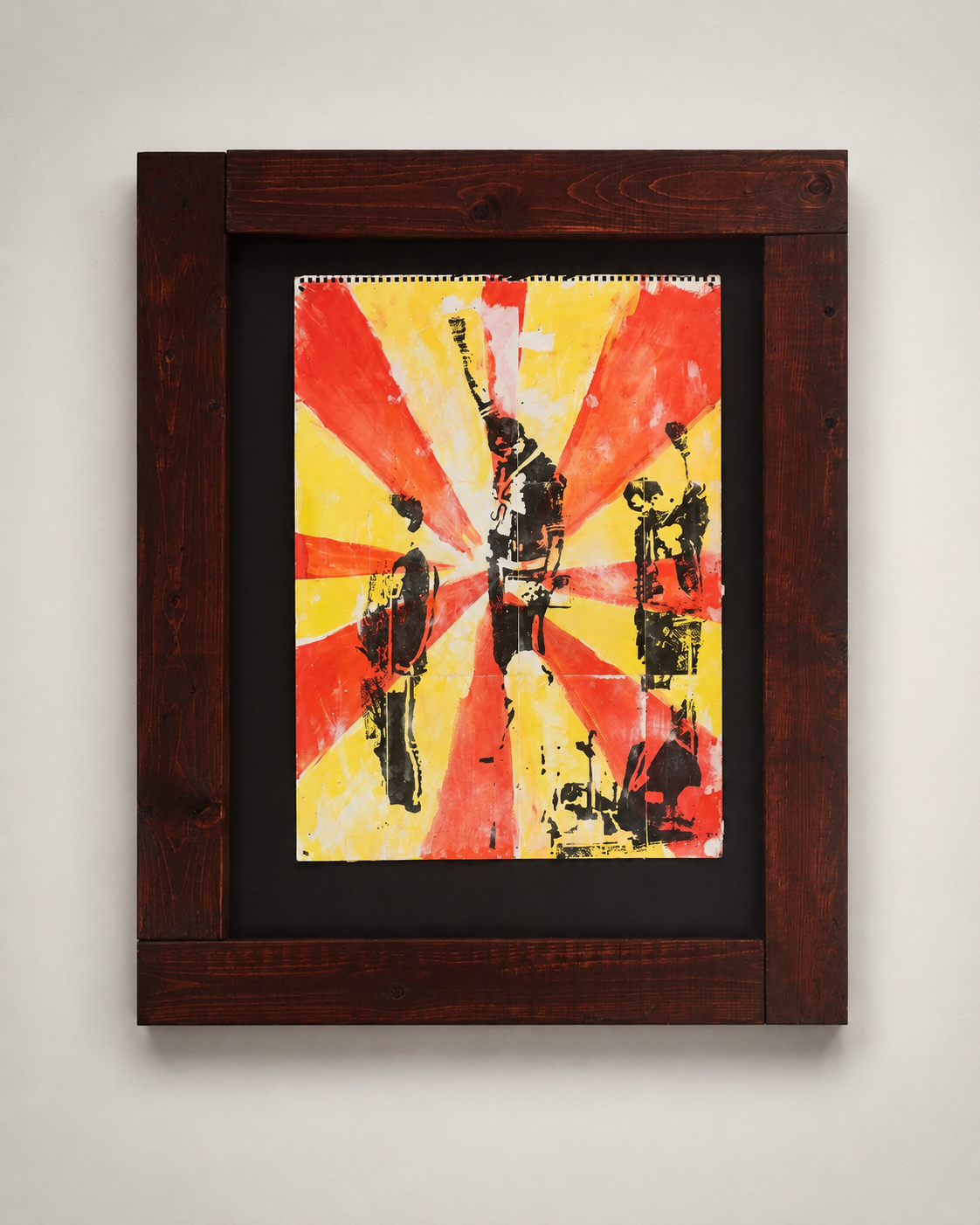
"without anthem" reinterprets the 1968 Olympic podium protest of Tommie Smith and John Carlos as a field of urgency, memory, and political heat. Rendered in watercolor on heavy paper, the work transforms one of the twentieth century’s most enduring images of athlete activism into a distressed, poster-like composition of black silhouettes and radiating red-yellow force. Rather than offering literal historical illustration, the painting compresses the event into an icon: the raised arm as signal, the podium as pressure point, and the body as a vehicle for public dissent.
The work draws its power from the historical weight of the Mexico City protest itself. Smith and Carlos, acting in connection with the Olympic Project for Human Rights, used the victory stand to protest racism and the broader condition of Black human rights in the United States and beyond. Their black gloves, shoeless black socks, and OPHR badges turned the medal ceremony into an international indictment. That act came at immense personal cost, but it permanently altered the relationship between sport and political speech.
In this painting, the historical image is not preserved as monument so much as reactivated as visual voltage. The three figures appear fragmented, almost scorched into the page, while the radiating field behind them suggests both spotlight and alarm — the glare of world attention and the heat of unfinished struggle. The result is a work that treats the 1968 protest not as closed history, but as a still-living charge. Before the Anthem Ended is ultimately less about commemoration than continuation: a reminder that the raised fist on the podium was never only about a moment, but about the ongoing demand that Black dignity be seen, heard, and defended in public.

13
"It Looked Like Fire"
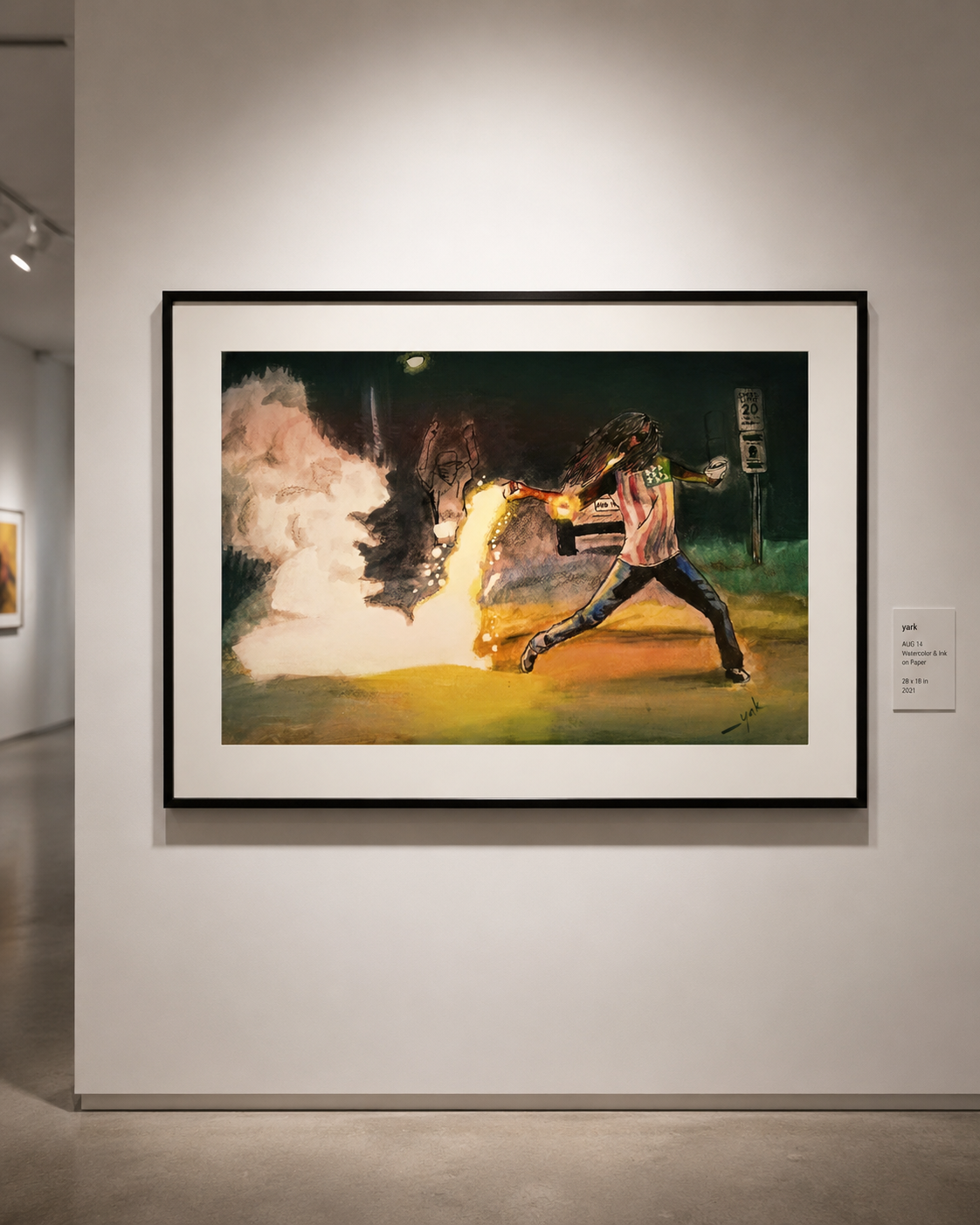
"It Looked Like Fire" is a portrait of Edward Crawford Jr., one of the most enduring figures associated with the Ferguson uprising. Drawn only days after the events in Ferguson, the work captures Crawford in the midst of confrontation, motion, and civic rupture — before his later death transformed his public image from protest icon into something even more haunting.
Set against a field of smoke, fire, and surveillance, the drawing does not present protest as spectacle. It presents protest as historical necessity. Crawford’s body occupies the center of the composition as both witness and agent, draped in a fractured American flag that turns national symbolism into indictment. The surrounding details — the speed-limit sign, the vehicle, the dim streetlight, the haze of force — anchor the work in the visual atmosphere of Ferguson, where ordinary public space became a stage for state power, grief, refusal, and global attention.
The significance of the work deepens in hindsight. What may once have read as an immediate response to the uprising now also functions as an unintended memorial. Because it was made before Crawford’s death, the drawing preserves him at the threshold between person and symbol, before mourning fully absorbed the image. In doing so, it stands as both document and elegy: a record of a revolutionary figure and a reminder of how often Black resistance is followed by Black loss.

14
NOV 08: dein ja
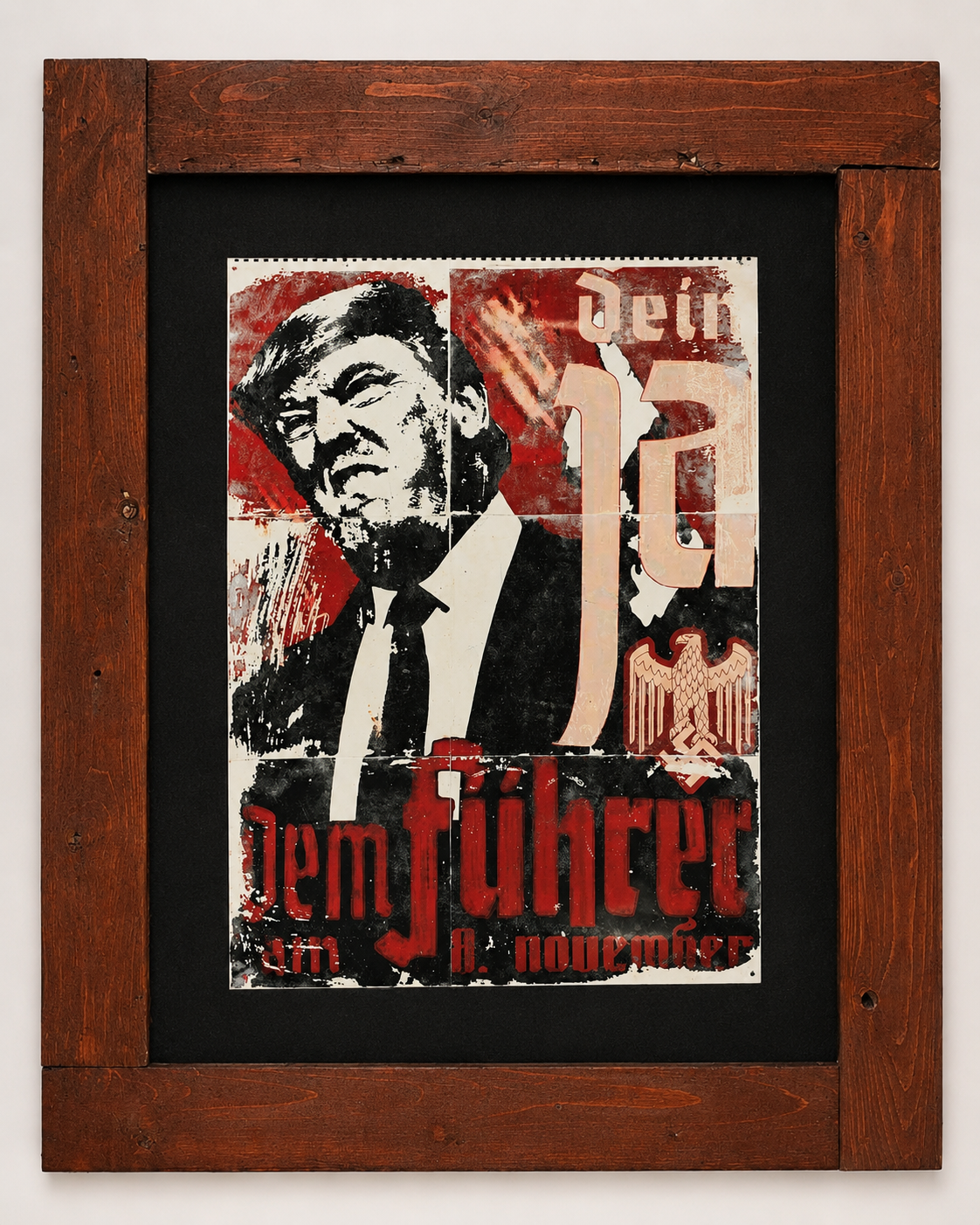
"November 8: Dein Ja", America is a lost 18 × 24 inch watercolor on heavy watercolor paper that confronts the election of Donald J. Trump as a crisis of image, consent, and historical memory. Built from the visual grammar of authoritarian propaganda — blackletter typography, red-black-white contrast, eagle iconography, monumental portraiture, and the command structure of “yes” — the work transforms November 8, 2016 into a damaged political relic.
At its center is Trump not as a private individual, but as a manufactured political image: a face hardened into stencil, slogan, and spectacle. The Germanic phrase structure, echoing “your yes to the leader,” reframes Election Day as a ritual of authorization. The painting does not claim that America became Nazi Germany on November 8. Its accusation is more precise: that American democracy contained visual, emotional, and institutional pathways through which authoritarian performance could be recognized, rewarded, and elevated.
The work’s material contradiction gives it force. Watercolor, usually associated with delicacy and transparency, is pushed into the language of decay: bleeding pigment, distressed surface, poster residue, archival damage. The image appears less painted than excavated, as if pulled from the aftermath of a political disaster.
What makes the piece enduring is its refusal to treat propaganda as something safely buried in the past. It shows how the old grammar of obedience can reappear inside modern electoral culture — not through exact repetition, but through translation. In this painting, November 8 is not only a date. It is the moment the “yes” becomes visible.
- A gallery-style image of a mixed-media watercolor painting in a thick rustic dark-wood frame with a deep black mat. The artwork shows a ghostly black-and-white child figure, interpreted as Ruby Bridges, walking with a small dark school bag while being escorted from school. Her white dress stands out against a fractured background of black architectural blocks, smoky blue marks, red and pink washes, and rust-orange staining. The top edge of the heavy paper is perforated like a torn notebook page, reinforcing the school reference. The surrounding frame is heavy and handmade-looking, giving the piece the feeling of a recovered historical relic or shrine.
- A gallery-style mock-up of a framed political parody painting mounted on a clean white wall above a concrete floor. The artwork sits inside a thick, rustic dark-stained wooden frame with a black backing. Centered within it is a distressed, jagged-edged acrylic painting on paper parodying the iconic “ain't no we” poster. A Hillary Clinton-like figure in a blue work shirt flexes her arm in the Rosie the Riveter pose against a yellow background, while the slogan at the top has been altered with rough red paint to read “We CAN’T Do It.” The painting’s creases, torn scraps, scuffs, rough paper edges, and worn surface remain visible as intentional parts of the work.
- Gallery-style mock-up of Crazy White Devils...Again!, an 18 x 24 inch watercolor on heavy watercolor paper, shown in a dark wooden frame with a black mat on a white museum wall. The artwork depicts a rider on horseback facing away from the viewer beneath a cropped green “Standing Rock Reservation” road sign, with industrial imagery, a social media notification icon, and a red breaking-news banner reading “Crazy White Devils...Again!” along the bottom. A wall label beside the framed work identifies the piece as a lost work from around 2016, created in response to the Standing Rock standoff against the Dakota Access Pipeline.
- Three unfinished 16 × 20 acrylic paintings on canvas hang side by side on a clean white gallery wall. The left canvas has a yellow background with splattered paint, a large white unfinished cloud-like form with drips, and the partial face of a young figure in a blue cap emerging from the bottom edge. The center canvas has a red background with black splatter marks, a large white dripping form, and a young figure leaning downward in quiet concentration. The right canvas has a pink-red background with splatter marks, a large white dripping form, and a seated figure bent forward near a small animal-like shape. Together, the works use graffiti-like splatter, portraiture, blank space, and unfinished passages to suggest memory, silence, youth, and language still forming.
- Three rustic dark-wood framed artworks hang in a row on a clean neutral gallery wall. The largest piece on the left features red and yellow sunburst rays behind black stencil-like figures, including a central figure with a raised arm. The middle work shows a loose watercolor-style performer or musician in gray, yellow, green, and red washes. The smaller work on the right is a warm-toned portrait of a person in a hat with a hand near their mouth. The scene is softly lit and presented as a polished gallery-style installation.
- A framed 18 × 24 watercolor painting on heavy paper hangs against a light wall. The artwork is divided into four distressed, poster-like panels in red, orange, yellow, blue, black, and white. In the upper-right panel, a black-and-white stenciled figure representing Assata Shakur appears with her head lowered and hands gathered near her chest, suggesting vulnerability and arrest. The surrounding panels contain fragmented silhouettes, heavy black marks, and saturated washes that evoke police authority, heat, violence, media distortion, and archival rupture. The painting is mounted inside a rustic dark wooden frame with a black backing, giving the lost work the feel of a preserved political artifact.
- A framed watercolor portrait of college-era Barack Obama hangs on a neutral gallery wall. The painting shows him wearing a wide-brimmed brown hat and a pale collared shirt, his hand raised near his mouth as if laughing, thinking, or smoking. Loose washes of blue, violet, red, and brown shape his face and clothing. Across the torn, irregular top edge of the paper, faded block letters read “LEGALIZE IT.” The artwork is mounted in a rustic dark wood frame with a black mat, giving the piece a recovered, archival feel.
- An 8 × 10 inch acrylic painting on cedar wood honoring Zeta Phi Beta Sorority. The composition features a layered mixed-media-style portrait with a warm brown cedar background and a rough white painted silhouette framing the central image. Near the top, a woman wears a wide golden hat marked with the Greek letters “ΖΦΒ,” with deep blue shadowing beneath the brim. To the left, a dark figure and expressive hand gesture add movement and contrast. On the right, a smaller standing woman in a white coat appears collaged into the scene. At the bottom, a white dove emerges from abstract blue, green, and red painted forms. The work uses Zeta Phi Beta’s royal blue and white symbolism while preserving a raw, handmade, archival quality.
- An 8 x 10 inch acrylic painting on scalloped cedar wood honoring Omega Psi Phi fraternity, featuring a dense, symbolic collage-like scene. A bearded male figure in deep purple tones lifts or cradles a small child with raised arms, surrounded by shadowed figures, a snarling dog or wolf head, and warm brown cedar textures. The shaped wooden plaque has a distressed amber finish, giving the work the feel of a handmade devotional object or fraternity tribute.
- A framed 18 × 24 mixed-media watercolor painting of Muhammad Ali rendered in a high-contrast black-and-white stencil style. Ali appears at the center with his mouth open and arms in motion, surrounded by explosive washes of orange, yellow, red, green, and black. Dark circular marks move across the upper background like lights, punches, or camera lenses, while red and green fields anchor the lower half. The paper sits inside a black mat and dark rustic wooden frame, giving the piece a recovered, archival gallery presentation.
- An 8 × 10 acrylic painting on cedar wood honoring Alpha Kappa Alpha Sorority. The composition features a warm reddish-brown textured background with an Africa-shaped opening at the center. Inside the opening, a young Black woman with hoop earrings looks upward with her hands clasped near her chin, surrounded by layered green imagery, a frog motif, pink-and-green symbolic forms, and a repeated group of women in green gathered like a chorus or sorority line. The piece has an intimate, devotional quality, connecting AKA sisterhood, ancestry, transformation, and collective legacy.
- A framed 18 × 24 watercolor painting hangs on a neutral gallery wall. Inside a thick, dark reddish-brown wooden frame, three distressed black stencil-like figures stand against a bold red-and-yellow radial burst. The central figure raises one arm upward, referencing the 1968 Olympic protest by Tommie Smith and John Carlos. The work has a raw, poster-like protest aesthetic, with rough watercolor textures, fragmented silhouettes, and visible paper perforations along the top edge.
- A dramatic charcoal and conté drawing on archival paper depicts a Ferguson protester in motion at night, lunging across the street while handling a bright flaming tear-gas canister. The figure wears a loose American flag–patterned shirt, dark pants, and sneakers, with long dark hair obscuring the face. A large plume of pale smoke erupts on the left, while a ghostly background figure raises both arms behind the firelit haze. A vehicle marked “AUG 14” and a “Speed Limit 20” sign appear in the dark urban background. The scene is rendered with rough, urgent linework, smoky blacks, fiery yellows and oranges, and a tense atmosphere of protest, surveillance, and resistance.
- A framed 18 x 24 inch political watercolor painting on heavy paper. The distressed red, black, and white composition depicts Donald J. Trump in a stark propaganda-style portrait, with German blackletter text reading “Dein Ja dem Führer” and the date “8 November.” The work is mounted against a black backing inside a rustic dark wooden frame, photographed in a clean gallery-style presentation.
bottom of page